Thermal Shock & Annealing Curvatures
Annealing is the disciplined thermodynamics of stress relief. Because glass is a poor conductor of heat, rapid temperature drops trigger internal tensile fractures. Precise lehr ramps ensure structural durability and dimensional stability.
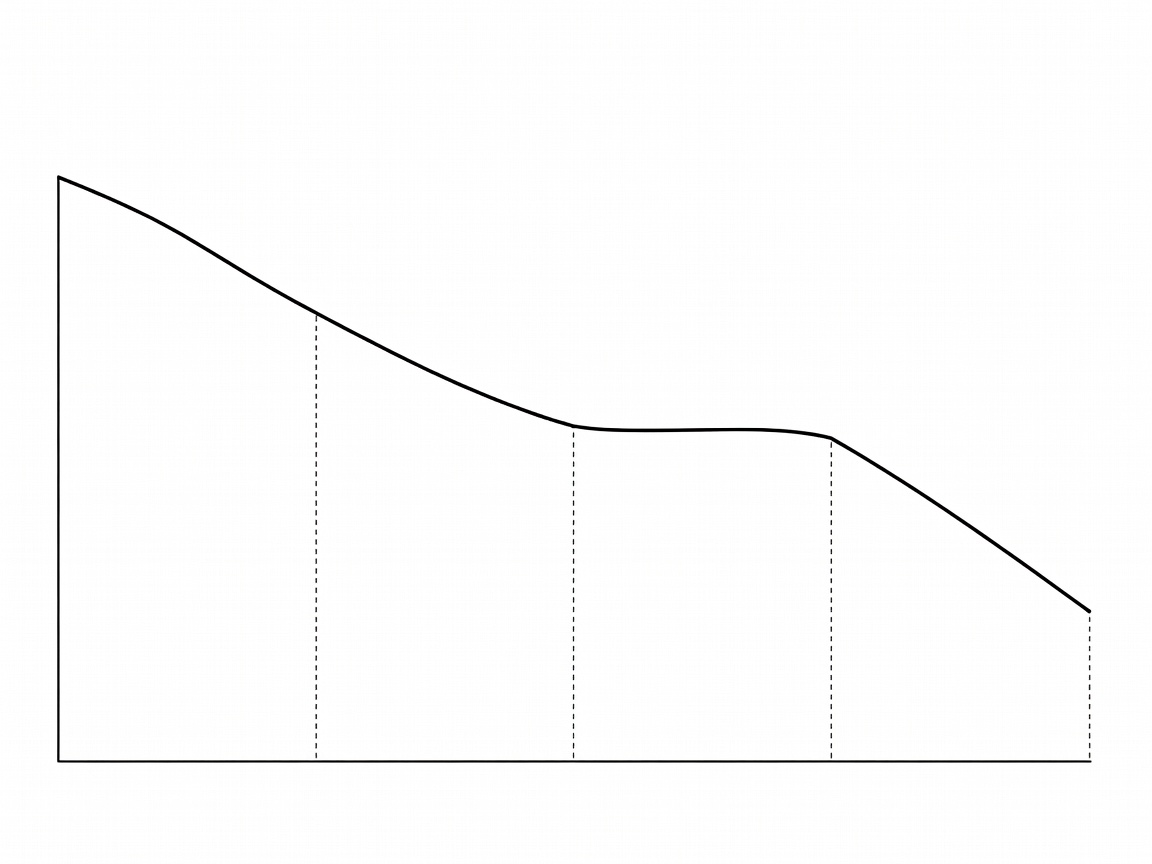
The Four Phases of Stress Dissipation
-
Phase 1: Isothermal Equalization (Soak) 510°C – 565°C
The workpiece is stabilized at the upper annealing point (viscosity approximately 10¹³ Poise). At this stage, the glass matrix is soft enough for internal atomic dislocations to relax and equalize without causing plastic sag or deformation under gravity.
-
Phase 2: Critical Ramp to Strain Point Down to 470°C – 510°C
The single most hazardous interval. The glass descends through its glass transformation range to the strain point (viscosity 10¹⁴·⁵ Poise). The temperature gradient between core and surface must not exceed 5°C; otherwise, permanent shear stresses will freeze permanently into the molecular lattice.
-
Phase 3: Post-Strain Stabilization Down to ~370°C
Past the strain point, glass behaves strictly as an elastic brittle solid. Viscous deformation is no longer possible. Cooling rates can be doubled, though thermal gradients that exceed tensile strength limits must still be strictly prevented.
-
Phase 4: Fast Linear Descent Down to Ambient (25°C)
Once below 350°C, radiant and convective cooling accelerates down to room temperature. Once ambient temperatures are reached, the kiln or lehr can be opened safely without risk of thermal shock breakage.
Annealing Schedule Programmer
Select the material formulation and thickness of the thickest cross-section in your piece to calculate a calculated ramp down schedule.
Calculated Lehr Ramp Schedule
Composition: --
| Phase | Programmed Rate & Target |
|---|---|
| 1. Soak Phase | -- |
| 2. Critical Ramp (to Strain Pt) | -- |
| 3. Elastic Cooling Ramp | -- |
| 4. Terminal Descent | -- |
| Total Cycle Duration | -- |
*Calculations based on standard Adams & Williamson glass cooling stress formulas. For solid cast glass monoliths over 50 mm, add a 40% margin of safety.
Polariscope Inspection & Strain Birefringence
How do thermal engineers confirm successful annealing? Annealed articles are examined between cross-polarized light filters (a polariscope). Glass under mechanical or thermal strain rotates the polarization angle of passing light rays, revealing vibrant rainbow-colored fringe bands (isochromatics). In properly annealed float or optical glass, the polariscope field displays zero color fringing, exhibiting a uniform deep velvet black field.
Need to Compare with Chemical Toughening?
Annealing removes strain to avoid spontaneous cracking, whereas tempering intentionally induces controlled compressive stress to enhance impact resistance.
Review Chemical Strengthening Mechanisms →