Chemical Strengthening & Ion Exchange
While thermal tempering utilizes air quenching to induce mechanical compression, chemical ion exchange achieves extraordinary surface strengthening on sub-millimeter profiles without optical distortion or bow warping.
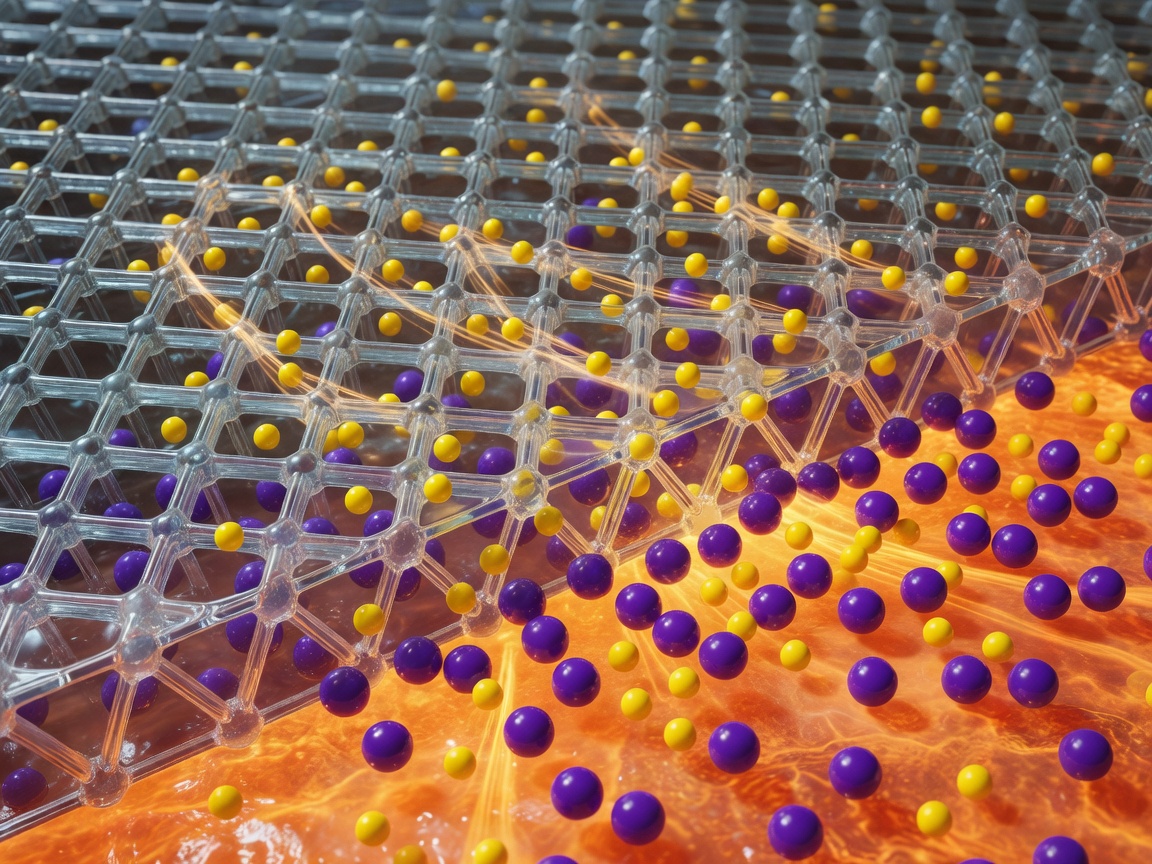
The "Stuffing Effect" Explained
Glass breaks solely from surface tensile strain. If an engineered compressive stress layer can be forged across the outermost microns of the glass, external bending or point impacts must first overcome this compressive layer before a flaw can initiate crack propagation.
In chemical strengthening, finished glass articles are submerged into a bath of high-purity molten potassium nitrate (KNO₃) held between 390°C and 440°C. Because this thermal window sits safely beneath the glass strain point, the physical matrix cannot flow or relax.
Through thermal diffusion, sodium ions (Na⁺) with an ionic radius of 1.02 Å migrate out of the silicate surface into the molten salt. Simultaneously, larger potassium ions (K⁺) with a radius of 1.38 Å migrate from the liquid into the vacancies left behind. Wedging larger potassium ions into molecular pockets built for smaller sodium atoms generates tremendous compressive stress—frequently exceeding 800 to 950 megapascals (MPa).
Physical Air Quenching
Process: Rapid blast of chilled air onto 650°C softening float glass.
Min Thickness: Typically 3.0 mm (difficult below 2.0 mm).
Compressive Layer: Deep (~20% of thickness), but lower magnitude (100–150 MPa).
Post-Processing: Absolutely cannot be cut or drilled post-temper; will shatter into dice.
KNO₃ Ion Exchange
Process: 420°C molten salt immersion for 6 to 16 hours.
Min Thickness: Down to 0.1 mm ultra-thin cover glass.
Compressive Layer: Shallow (20 to 60 µm Depth of Layer), but ultra-high magnitude (>800 MPa).
Post-Processing: Retains high optical flatness with zero roll-wave distortion.
Aluminosilicate vs. Soda-Lime Formulations
Traditional soda-lime float glass can undergo chemical tempering, but its dense silica network inhibits deep potassium migration, limiting Depth of Layer (DoL) to roughly 15–20 µm. Modern consumer electronics and aerospace windshields deploy alkali-aluminosilicate formulations (incorporating 10–15% Al₂O₃). The open tetrahedral aluminum-silicon network facilitates rapid, deep ion diffusion, achieving DoL figures past 50 µm with profound resistance to drop fractures.
"Depth of Layer (DoL) is the primary determinant of real-world survival. If a sharp asphalt particle scratches deeper than the ion-stuffed compressive zone, the crack immediately taps into the central tensile core, causing sudden catastrophic rupture." Director of Materials Characterization
Quality Verification & FSM Refractometry
Because the ion-exchanged compressive skin is mere microns thick, standard mechanical destructive testing is supplemented with non-destructive differential refractometry (FSM instruments). Polarized light guided through the surface layer undergoes phase shifts governed by the photoelastic effect, outputting a precise optical fringe pattern that maps:
- CS (Compressive Stress): Measured in MPa.
- DoL (Depth of Layer): Depth where compression crosses zero to tension, measured in microns.
- CT (Central Tension): Balanced interior tensile strain, ensuring safety against spontaneous explosive failure.
Explore Related Annealing Protocols
Before any glass article can be successfully submerged into a chemical tempering bath, all residual thermal stresses from initial forming must be eliminated through annealing.
Examine Annealing Curves