Studio Offhand Glassblowing
Contrasting the mechanized consistency of float glass lines, studio glassblowing remains an intensely physical art form anchored in the sensory intuition of thermal viscosity and kinetic equilibrium.
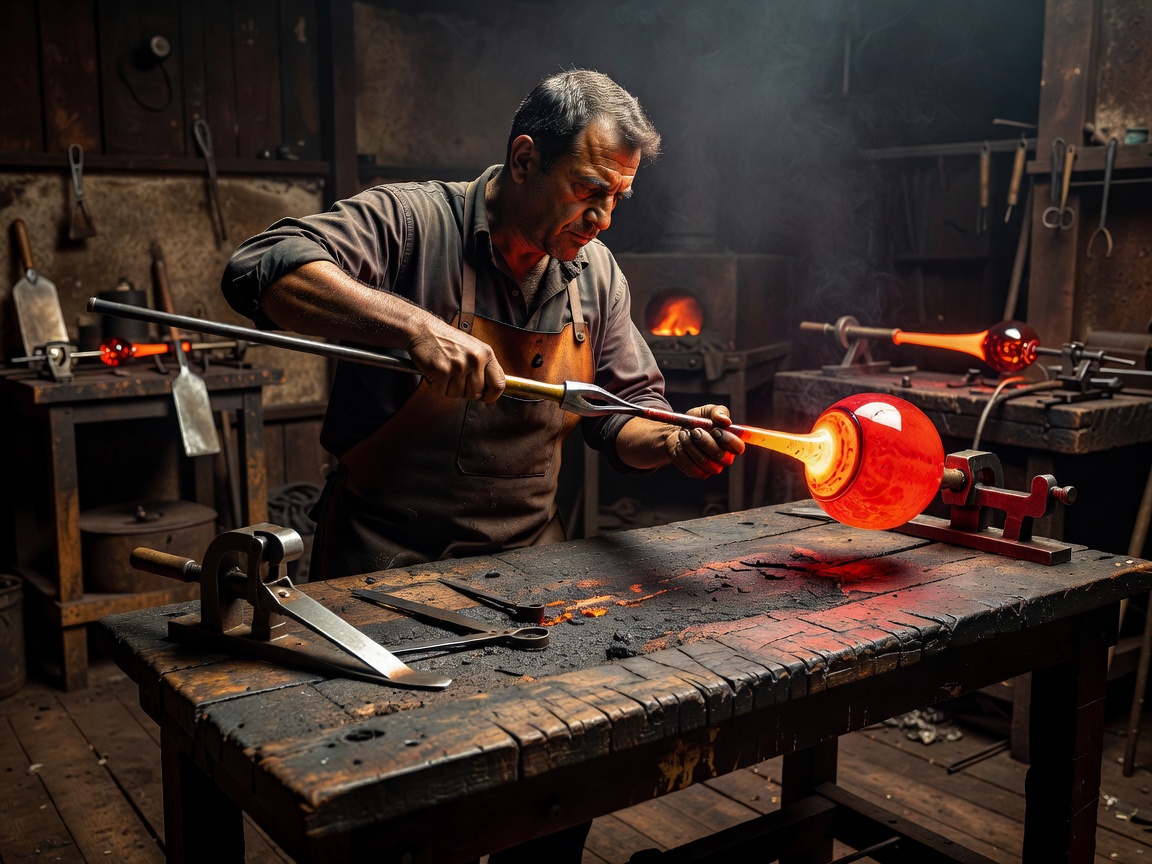
The Gather: Fluid Extraction
The process initiates at the crucible mouth. The gaffer inserts the preheated tip of a hollow stainless steel blowpipe into molten crystal (~1,150°C), steadily turning the pipe along its axis like honey wound onto a dipper. Rotational velocity must counteract gravitational drooping. Multiple gathers can be layered, with intermediate cooling and marvering to build thermal mass.
Marvering & The First Bubble
Once gathered, the molten globule is rolled against a chilled, polished steel or cast-iron surface known as the marver. Marvering accomplishes two foundational tasks:
- It produces a circular, concentric profile concentric with the blowpipe core.
- It forms a dense, chilled outer "skin" that constrains pneumatic expansion, ensuring the subsequent initial puff forms a uniform internal pocket instead of blowing out through the tip.
"Rotation must never cease. From the second the gather leaves the tank until the finished piece is severed into the vermiculite or annealing lehr, hesitation yields asymmetric wall collapse." Studio Master Glassblower
Bench Tools & Dynamic Manipulation
Seated at the glassblower’s bench, the artisan rolls the pipe continuously along the arms while wielding classical carbonized and metal instruments:
The Jacks
Spring-steel blades used to constrict a neck ("jackline") near the pipe tip, open vessel lips, and shape external profiles via friction.
Cherrywood Blocks
Hollowed fruitwood scoops soaked in water. Contact with the 1,000°C gather vaporizes a microscopic steam cushion, letting the artisan shape globes without scorch rings.
Diamond Shears
Heavy steel shears designed to excise excess molten glass folds or trim uneven vessel rims while the material is still ductile.
The Punty Rod
A solid iron rod tipped with a small dab of hot glass, welded onto the base of the vessel to permit severing from the blowpipe for top finishing.
The Puntil Transfer & Opening the Lip
To finish the vessel’s opening, the base is adhered to the punty rod. A thermal shock drop of water is applied to the previously scored jackline, followed by a sharp tap on the pipe. The vessel snaps clean at the neck, transferred entirely to the punty. It returns repeatedly to the roaring glory hole reheat chamber (1,200°C) until the mouth softens sufficiently to be spun open via centrifugal flares or jack blades.
Cold Working: Refining the Severed Foot
Following a 14-hour controlled annealing cycle in the lehr to remove cooling strains, the piece undergoes cold-shop dressing. The jagged punty scar on the base is ground flat on cast-iron lapping wheels using 220-grit silicon carbide slurry, step-polished with diamond resin pads, and brought to a luminous high-gloss mirror finish using cerium oxide paste.
Critical Notice for Glass Artisans
Studio glassblowing requires rigorous compatibility testing. Never mix COE 96 batch crystal with COE 90 casting billets or COE 85 commercial sheet glass. Disparate thermal contraction curves will introduce catastrophic shear forces across the fusion line, causing spontaneous fracturing.
Review Annealing Curve Calculator →