The Pilkington Float Line Mechanics
Invented by Sir Alastair Pilkington in the late 1950s, the float glass method eliminated the laborious twin-grinding and polishing phases required by plate glass manufacturing, giving birth to modern architectural facades.
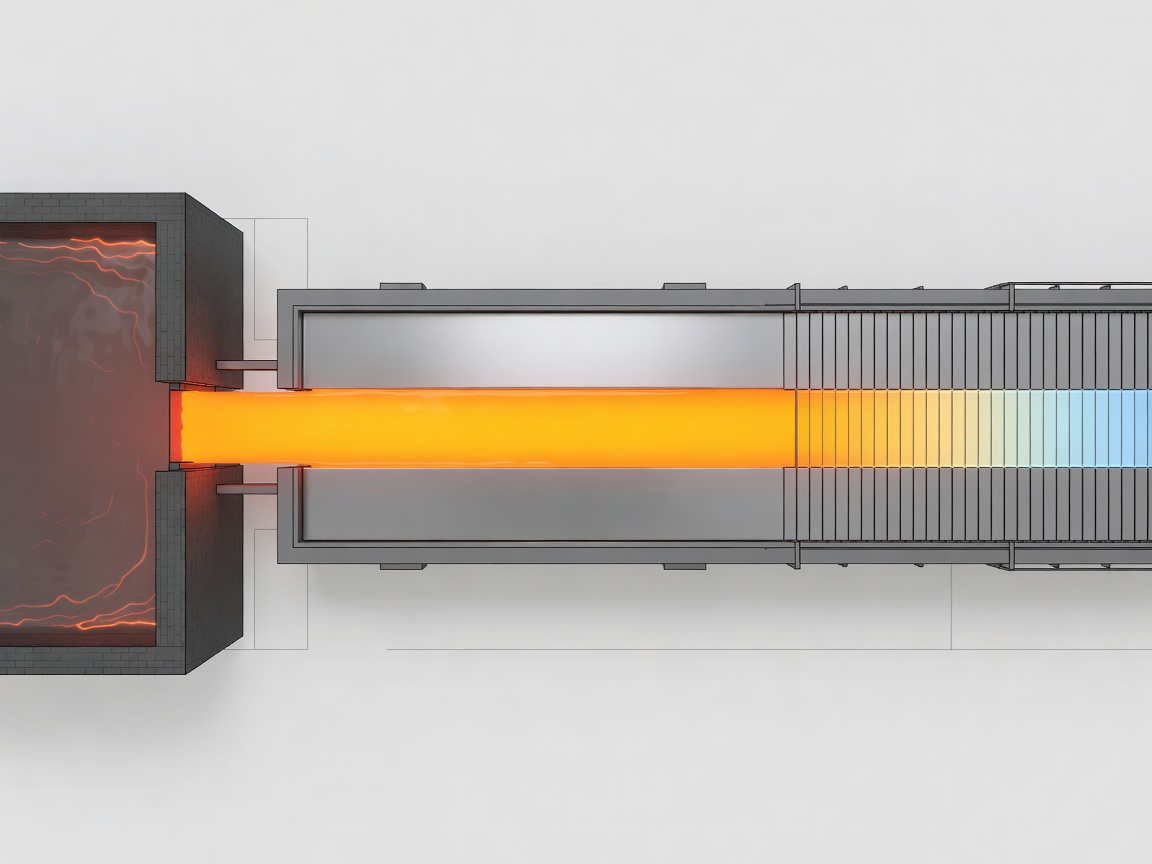
1. The Raw Batch & Melting Tank
A standard soda-lime float line runs uninterrupted for 12 to 15 years before tank refractories necessitate reconstruction. Raw constituents are meticulously homogenized:
- Silica Sand (SiO₂): 72% – network former.
- Soda Ash (Na₂CO₃): 13–15% – flux to lower melting temperature from 1,720°C to approx. 1,500°C.
- Dolomite & Limestone (CaCO₃, MgCO₃): 9–11% – network stabilizers against water dissolution.
- Alumina (Al₂O₃): 1% – boosts chemical durability.
- Cullet (Recycled Glass): 20–30% – accelerates fusion and slashes energy draw.
Melting happens in massive regenerative cross-fired furnaces holding up to 2,000 metric tons of liquid glass. Temperatures peak at 1,580°C, where mechanical bubbling and chemical refining agents (such as sodium sulfate) evacuate trapped gas inclusions.
2. Delivery Onto Liquid Tin
Refined glass flows through a canal controlled by a refractory gate (the "tweel") at 1,100°C over a spout onto the surface of molten tin. Liquid tin serves as the ideal flotation substratum because:
- Its liquid phase extends broadly from 232°C to 2,602°C, remaining fluid throughout the entire shaping and solidifying range of glass (1,100°C down to 600°C).
- Its specific gravity (~6.5 g/cm³) prevents silicate glass (~2.4 g/cm³) from sinking or forming surface hollows.
- It possesses virtually zero mutual solubility with molten silicate.
"Oxidation is the absolute nemesis of float tin. If trace oxygen breaches the hood, stannic oxide dross clings to the glass ribbon, yielding catastrophic optical haze. Nitrogen-hydrogen atmospheres are maintained under positive pressure 24 hours a day." Senior Refractory Metallurgist
3. Ribbon Thinning & Top Rollers
Left unmanipulated, natural forces settle the glass raft at exactly 6.88 mm. To generate standard commercial thicknesses such as 2 mm, 3 mm, or 4 mm, water-cooled toothed wheels (top rollers) penetrate the bath edges. By rotating faster than the conveyor speed, these rollers stretch the hot viscous ribbon sideways and longitudinally while maintaining absolute optical flatness.
4. The Annealing Lehr (Cooling Canal)
Upon emerging from the float chamber at approximately 600°C, the ribbon has hardened sufficiently to ride on ceramic rollers without marking. It enters an enclosed lehr—typically 100 to 150 meters long—where heat sensors and recirculating blowers adjust temperature downward in calculated increments until the ribbon reaches 60°C, ready for automated laser defect detection and diamond carbide cross-cutting.
Operational Summary: Continuous Float Facility
A typical high-output float line produces between 500 and 1,000 tons of flawless architectural glass per day, feeding construction projects, vehicle laminators, and mirror coating plants worldwide without shutting down for over a decade.
Examine the Cooling Ramp Math